The Clock Tower: the heart of the citadel
Discover the symbol of Sighișoara beyond its facade: history, the 1676 fire, the clock figurines, the museum and practical information.
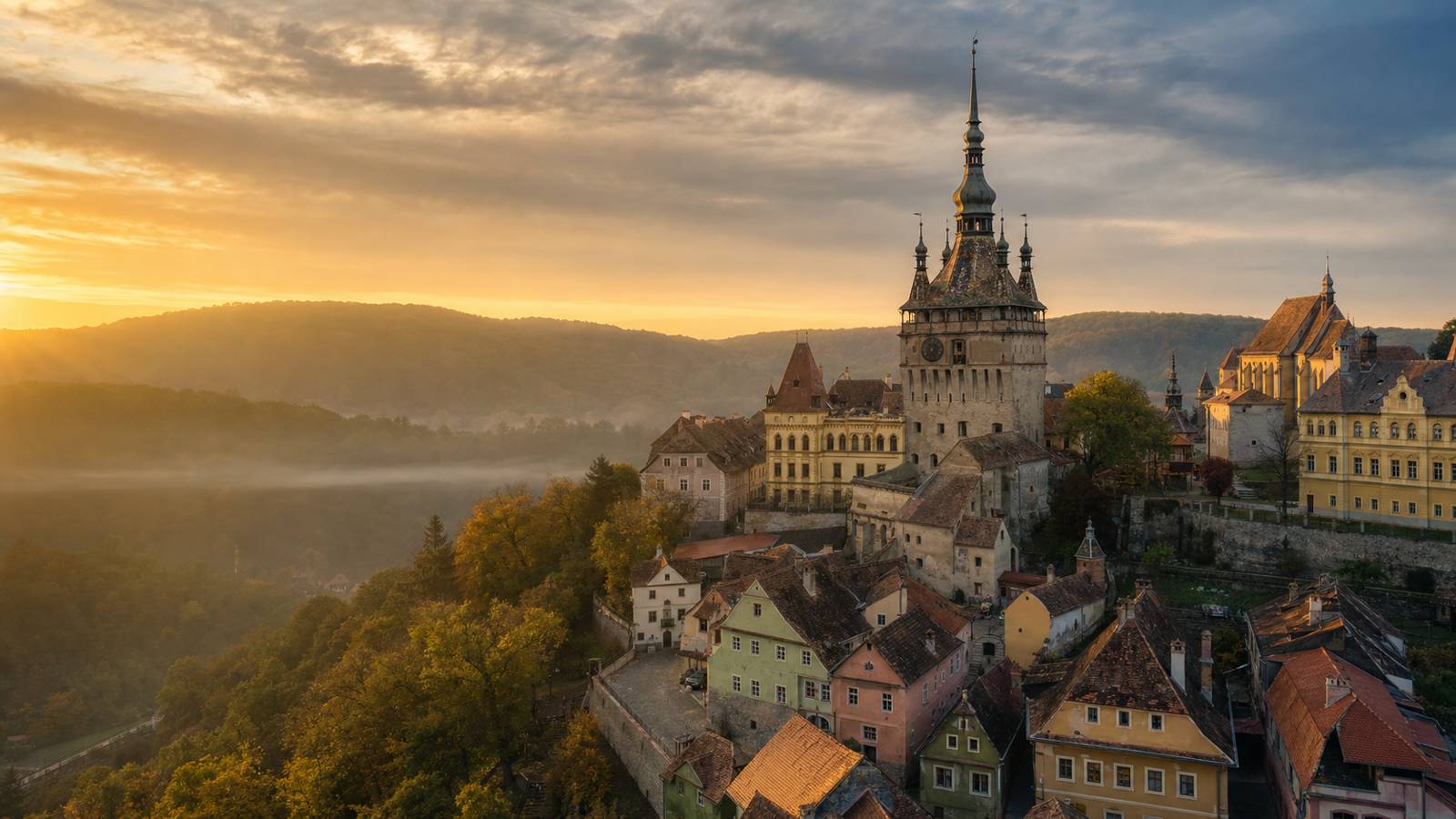
The Clock Tower was the citadel's main gate and the centre of its administrative life. Today it is the symbol of Sighișoara and the best introduction to the town's history: a 64-metre tower where defence, administration, craftsmanship and a touch of Baroque theatre come together.
A gate that became a town hall
The tower was built in the 14th century to defend the main entrance to the citadel. Because it was the sturdiest building in town, the community's leadership moved here too: the town council met in the first-floor hall until 1556. Of the 14 defence towers that once stood, nine remain, and the Clock Tower is the most massive of them.
The 1676 fire and the Baroque roof
On 30 April 1676, a fire destroyed about 80% of the town, including the tower's roof. Rebuilding lasted from March to September 1677 and was done by travelling craftsmen: Veit Gruber from Tyrol and Philip Bong from Salzburg, together with the carpenter Valentinus. That is when the tower got the silhouette you see today: the Baroque roof with turrets and onion shapes, visible from almost every corner of the town.
The clock and the figurines
The clock was installed in 1648, and the current mechanism, made by the Swiss firm Fuchs, has been running since 1906. Each of the two dials is 2.40 metres across. The most photographed details are the limewood figurines, about 80 centimetres tall: seven figures from Roman mythology marking the days of the week, from Diana (Monday) to Saturn (Saturday) and the Sun (Sunday).
What you see inside
Since 1899 the tower has housed the History Museum. You climb through the museum rooms to the gallery at the top, which offers the best panorama over the red roofs, the Lower Town and the surrounding hills. Below the tower is the Torture Room, the former military prison set up after 1677 and reopened to the public in 1998. It keeps the 6-kilogram stone that was hung around the necks of those punished at the pillory in Citadel Square. Johann Schuller von Rosenthal, a former mayor and the last person beheaded in the citadel, on 28 September 1703, was held here too.
Practical information
- Opening hours (15 May – 15 September): Tuesday–Friday 9:00–17:30, Saturday–Sunday 10:00–17:30.
- Opening hours (16 September – 14 May): Tuesday–Friday 9:00–15:30, Saturday–Sunday 10:00–15:30. Closed on Mondays.
- Tickets 2026 (Sighișoara City Hall): Clock Tower 50 lei (pupils/students 15 lei), Medieval Weapons Collection 20 lei, Torture Room 15 lei, combined ticket for all three 70 lei.
- Where: Piața Muzeului 1, at the entrance to the citadel.
- Recommended time: 45–60 minutes for the museum and the gallery.
Listen to the full story in the digital guide, right on the spot: https://ghid.exploresighisoara.ro/en/obiectiv/turnul-cu-ceas
Sources
Information checked on 12 October 2026.
- Sighișoara Clock Tower (Wikipedia): https://en.wikipedia.org/wiki/Sighi%C8%99oara_Clock_Tower
- Turnul cu Ceas (Romanian Wikipedia): https://ro.wikipedia.org/wiki/Turnul_cu_Ceas_din_Sighi%C8%99oara
- The pillory and the Torture Room (AGERPRES, 2019): https://agerpres.ro/2019/08/20/reportaj-mures-piatra-atarnata-la-gatul-celor-pusi-la-stalpul-infamiei-piesa-unica-pastrata-la-sighi--358062
- Museum prices 2026 (Sighișoara City Hall): https://primariasighisoara.ro/portal/mures/sighisoara/portal.nsf/pagini/serviciul+muzeul+de+istorie-00001E6A
- Museum opening hours: https://www.artline.ro/Turnul-cu-Ceas-Sighisoara---Adresa--program-si-bilete-30546-1-n.html